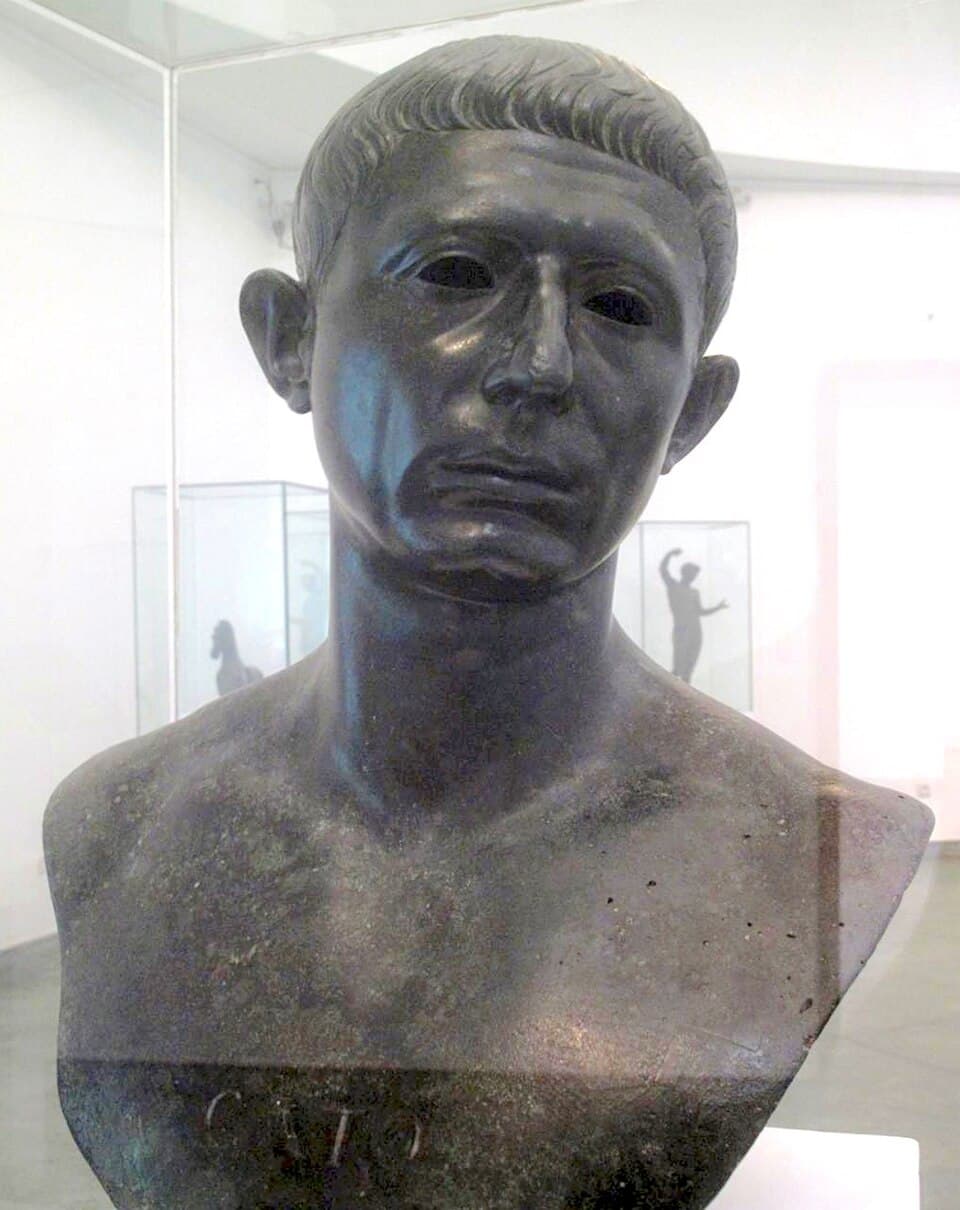
The Roman Stoa · 95–46 BC
Cato the Younger
Marcus Porcius Cato Uticensis
Rome's unbending conscience
“It is more certain that the immortal gods have given Cato as a pattern of a wise man to us, than that they gave Ulysses or Hercules to the earlier ages.”
His life
Cato was a Roman senator, great-grandson of a legendary censor, and the rare politician whose enemies conceded his honesty. In an age when every office in Rome could be bought, Cato as treasury official audited the books, prosecuted the corrupt clerks everyone else found convenient, and made exactness fashionable for about as long as he held the job. He wore a plain toga, walked where others rode, and voted his conscience with a stubbornness that infuriated allies and opponents alike.
He had studied Stoicism seriously and practiced it in the most public arena on earth. When Julius Caesar's ambition tipped the Republic into civil war, Cato — no admirer of Pompey either — chose the side he thought lawful. After the decisive defeat, holed up in the African city of Utica, he arranged safe passage for his companions, spent his last evening reading Plato on the soul, and took his own life rather than let Caesar make a show of pardoning him. Caesar's clemency was real, and it was also power; Cato refused to owe his life to a man he believed had stolen Rome's liberty.
Rome never got over it. Within a generation 'Cato' meant incorruptibility itself. For the Stoic writers he became the great modern example — proof that the sage was not a thought experiment. Seneca, who fills his essays with him, put it flatly: the gods gave us Cato as a pattern of the wise man, surer than any hero of legend.
What he taught
Integrity is not for sale
Cato's public life was one long demonstration that a person can hold power without being held by it. The Stoics pointed to him whenever anyone said virtue was fine in theory.
Principle has a price
His refusals cost him alliances, elections, and finally his life. The Stoic claim is not that integrity is free — it is that what you keep by paying is worth more than what you save by folding.
The exemplar
The Stoics taught by example as much as argument: pick a standard, they said, and live as if that person were watching. For Rome, and for Seneca's essays, that standard was Cato.
In the Library
Cato wrote no philosophy — he was philosophy, as far as Rome was concerned. You meet him constantly in Seneca's essays in the Library, where he appears as the standing proof that the Stoic ideal can be lived.