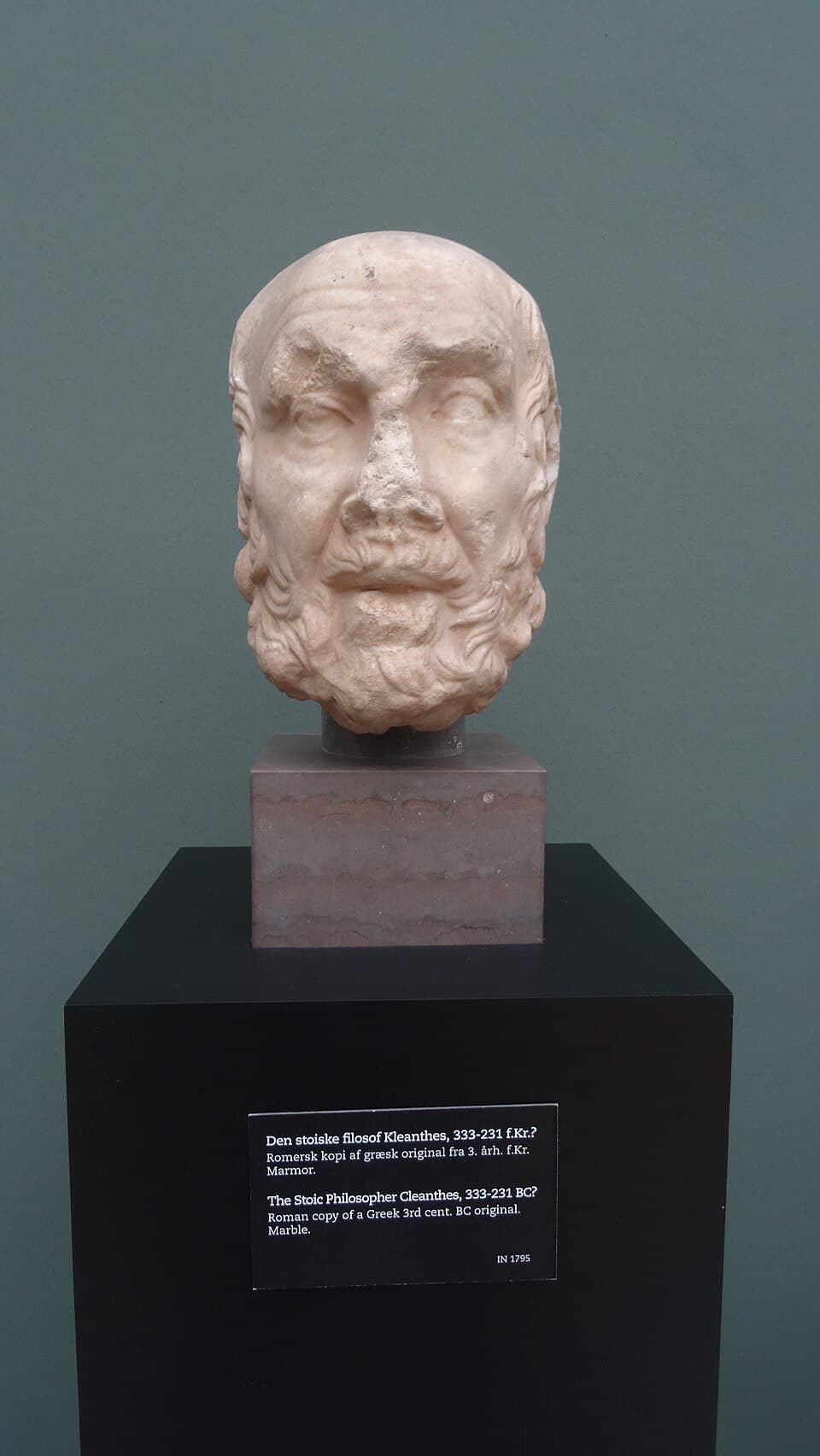
The Early Stoa · c. 330–230 BC
Cleanthes
The boxer who hauled water by night to study by day
“Lead me, Zeus, and thou, O Destiny, wherever your decrees have fixed my lot. I follow cheerfully; and, did I not, wicked and wretched, I must follow still.”
His life
Cleanthes came to Athens from Assos, a town on the Aegean coast of Asia Minor, with four drachmas in his pocket and a boxer's build. To afford philosophy he worked nights: hauling water for a gardener, kneading dough for a baker. By day he sat with Zeno. The Athenians nicknamed him the Well-Water-Gatherer; when a court demanded to know how a man with no visible means lived so decently, he produced his employers as witnesses, and the jurors moved to reward him.
He was not quick, and he knew it. Fellow students mocked him as slow; he called himself a bronze tablet — hard to write on, but what was written stayed. When Zeno died, it was Cleanthes, not a cleverer rival, who led the school, and he led it for over thirty years, holding it together through decades when its doctrines were under attack from every other school in Athens.
His deepest mark on Stoicism is its reverence. For Cleanthes the universe was not a machine but something closer to a living order worthy of devotion, and the good life meant consenting to it willingly. His Hymn to Zeus — the longest fragment of early Stoicism we still have — is philosophy written as prayer. Epictetus, three centuries later, told his students to keep its lines ready at hand for whatever fate brought.
What he taught
Persistence over brilliance
Cleanthes is the school's proof that character outlasts talent. He was mocked as a plodder and became the man Zeno trusted with everything he had built.
Willing consent to fate
His famous prayer asks Zeus to lead — and promises to follow willingly, because the unwilling get dragged along anyway. Freedom, for Cleanthes, is wanting what happens to happen.
Reverence for the rational order
Cleanthes gave Stoicism its pious voice: the cosmos as one living whole, worth honoring. The calm the Stoics promise is not resignation but trust in that order.
In the Library
Of everything Cleanthes wrote, only fragments remain — but among them is the Hymn to Zeus, the longest surviving piece of early Stoic writing, and the prayer Epictetus quotes at the close of the Enchiridion.