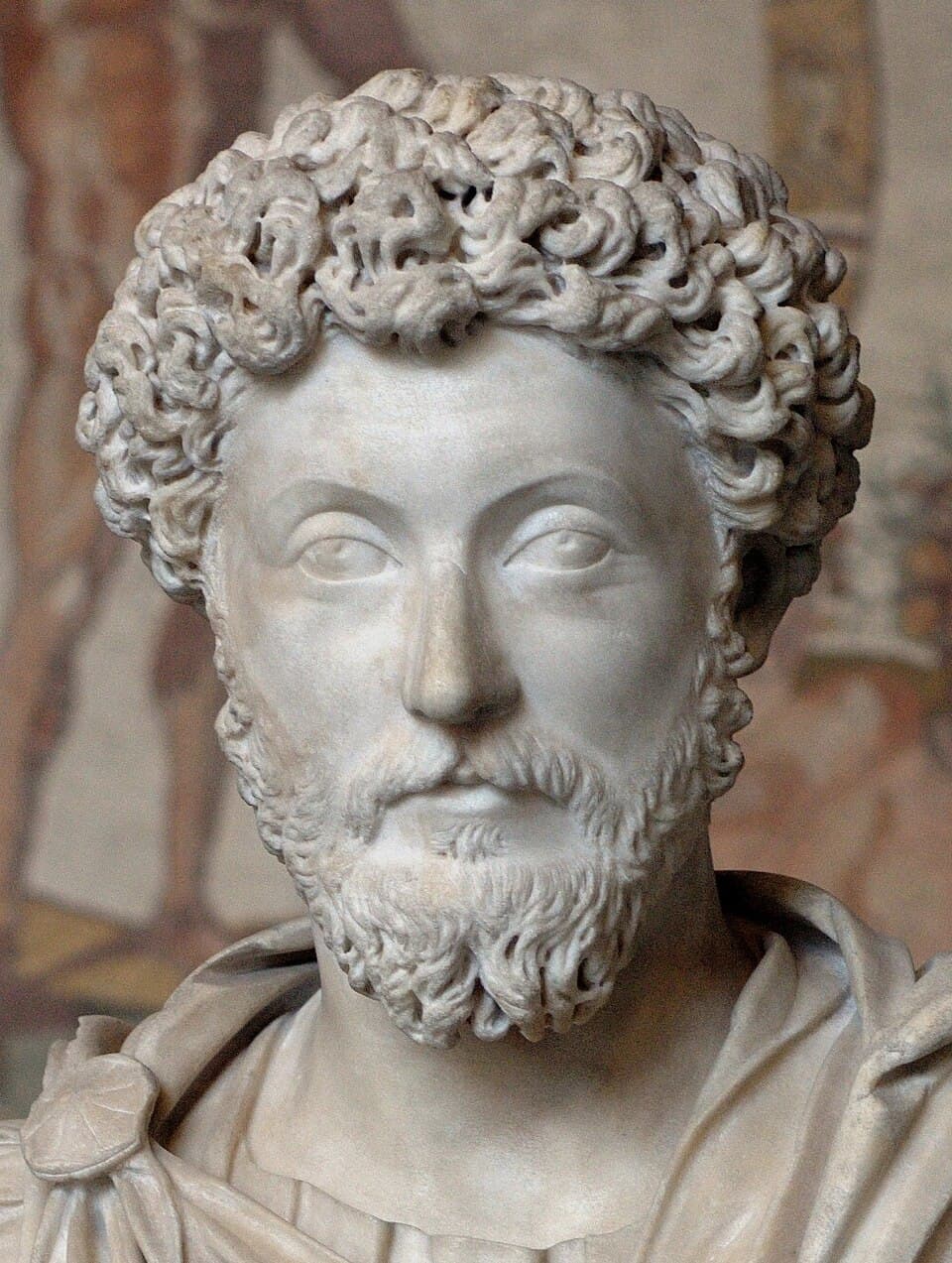
The Roman Stoa · AD 121–180
Marcus Aurelius
The emperor who wrote only to himself
“That which is a hindrance is made a furtherance to an act; and that which is an obstacle on the road helps us on this road.”
His life
Marcus was noticed early. The emperor Hadrian, charmed by the boy's earnestness, nicknamed him Verissimus — 'truest' — and arranged the adoption that set him on the path to the throne. He got the finest education in the empire and, at around age twenty-five, encountered the Discourses of Epictetus through his teacher Rusticus. The borrowed copy of a dead ex-slave's classroom notes did more to shape the most powerful man in the world than all his tutors in rhetoric combined.
He became emperor in AD 161, and almost nothing went well. A war with Parthia; soldiers returning with a plague that killed millions across the empire; Germanic tribes breaking the Danube frontier, pulling Marcus north for years of grinding warfare; a flood; a famine; finally the revolt of a trusted general. He was a man built for the study who spent two decades in an army tent, and he governed, by the account of even hostile historians, with patience and without cruelty.
In that tent, at night, he wrote Greek notes to himself that he never titled and never meant anyone to read — reminders to get out of bed, to forgive the obstructive colleague, to see the day's obstacle as the day's material, to hold his post like a soldier and die with a good grace when relieved. The notebooks survived him by accident and became the Meditations: the rarest document we have, the private voice of absolute power talking itself into being good. He died on campaign in AD 180, still writing, still unconvinced he had gotten there.
What he taught
The obstacle becomes the way
The mind converts every hindrance into material for action, he reminded himself in the middle of a war he never wanted. What blocks the plan becomes the plan.
The inner citadel
Retreat, he wrote, not to the seaside but into your own mind — the one fortress no plague, senate, or army can enter without your consent.
Do the thing at hand
His working method for impossible years: stop imagining the whole crushing future and perform the present action with care, as if it were your last.
You could leave life right now
Marcus kept death on his desk not as morbidity but as a lens: let it decide what deserves today, and how you treat the people in it.