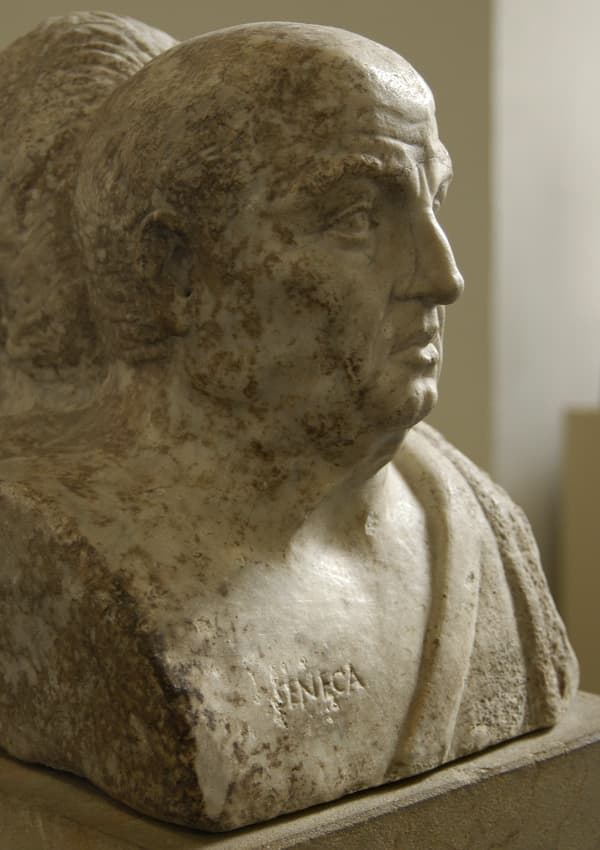
The Roman Stoa · c. 4 BC – AD 65
Seneca
Lucius Annaeus Seneca
Statesman, playwright, and the master of the philosophical letter
“It is not that we have a short space of time, but that we waste much of it. Life is long enough … if the whole of it is well invested.”
His life
Seneca was born in Corduba, Spain, and rose in Rome as an orator and senator so talented that one emperor reportedly considered having him killed out of envy. Another settled for exile: in AD 41 Claudius banished him to Corsica on a charge few historians believe. He spent eight years on that rock writing consolations — to his mother, among others, on the grief of his own absence — before the empress Agrippina recalled him for a fateful job: tutor to her twelve-year-old son, Nero.
When Nero took the throne, Seneca became the most powerful civilian in the empire, drafting speeches, steering policy, and growing enormously rich — a fact his critics never let him forget. The tension between his wealth and his philosophy is real, and he knew it; his answer, in essays like On the Happy Life, was that the wise man may hold fortune's gifts as long as he can drop them without flinching. In AD 62, as Nero curdled into tyranny, Seneca asked to retire, offering the emperor his entire fortune on the way out.
The retirement years gave us his masterpiece: the Moral Letters to Lucilius, one man writing to a friend about fear, time, friendship, illness, travel, and death — philosophy at the scale of a single Tuesday. In AD 65 Nero, sweeping up after a conspiracy Seneca probably had no part in, ordered his old tutor to die. Tacitus records the scene: Seneca calm, consoling his friends, dictating to the end — allowed at last to practice the lesson he had rehearsed in every letter.
What he taught
Time is the only possession
We guard our money and squander our hours. Seneca's most piercing theme: life is long enough if you actually live it, and no one hands your wasted years back.
Rehearse adversity
Set aside days to eat plainly and dress roughly, he advised, and ask: is this what I feared? Practicing loss in advance shrinks fortune's power to terrify.
Anger is temporary madness
His essay Of Anger is the ancient world's fullest anatomy of rage — how it starts, what it costs, and how a delay, a mirror, or a night's sleep starves it.
Philosophy between friends
The Letters model philosophy as correspondence: honest, specific, one day at a time. Wisdom, for Seneca, is something friends build in each other.
In the Library
- Moral Letters to Lucilius862 passages
- Of a Happy Life31 passages
- Of Anger105 passages
- Of Clemency38 passages
- Of Consolation: To Helvia20 passages
- Of Consolation: To Marcia30 passages
- Of Consolation: To Polybius20 passages
- Of Leisure9 passages
- Of Peace of Mind20 passages
- Of Providence11 passages
- On Benefits256 passages
- On the Firmness of the Wise Man21 passages
- On the Shortness of Life32 passages