The Early Stoa · c. 334–262 BC
Zeno of Citium
The merchant who lost everything and founded a school
“I made a prosperous voyage when I suffered shipwreck.”
His life
Zeno was a Phoenician merchant from Citium, a town on Cyprus. Somewhere around his thirtieth year, the story goes, he was shipwrecked near Athens and lost a cargo of purple dye — a fortune. Wandering the city, he sat down in a bookshop and heard the bookseller reading Xenophon's recollections of Socrates. Zeno asked where a man like that could be found. The bookseller pointed at Crates, a Cynic philosopher who happened to be passing, and said: follow him.
He did. For years Zeno studied with Crates and with the other schools of Athens — the Cynics' indifference to comfort and reputation, the logicians' rigor, the Academy's breadth. Around 300 BC he began teaching in his own right, not in a private garden like Epicurus but in the middle of the city, on the Stoa Poikile — the Painted Porch overlooking the marketplace. His students were called the men of the porch: the Stoics.
What he taught was startlingly simple at its core: the only true good is virtue — good character and good judgment — and the only true evil is its absence. Everything else people chase or flee, money, status, health, even life itself, is material to work with, not the measure of a life. Athens, a city not easily impressed, honored the foreigner with a golden crown and a public tomb; the decree said his life had matched his teaching. Looking back on the shipwreck that brought him to philosophy, Zeno liked to say it had been his most profitable voyage.
What he taught
Virtue is the only good
Everything Stoicism became grows from Zeno's claim: character is the one thing that is good in every circumstance, and nothing outside your character can make your life a failure.
Live in agreement with nature
Zeno's formula for the goal of life. Nature gave humans reason; living well means living by it — seeing things as they are and acting accordingly, rather than being dragged by fear and craving.
Philosophy in the marketplace
He taught on a public porch, not behind a garden wall. From its first day Stoicism was meant for people in the middle of life — merchants, soldiers, citizens — not for retreat from it.
In the Library
None of Zeno's books survive. What we know of him comes from later writers, above all Diogenes Laertius' life of Zeno — and from the school he left behind.
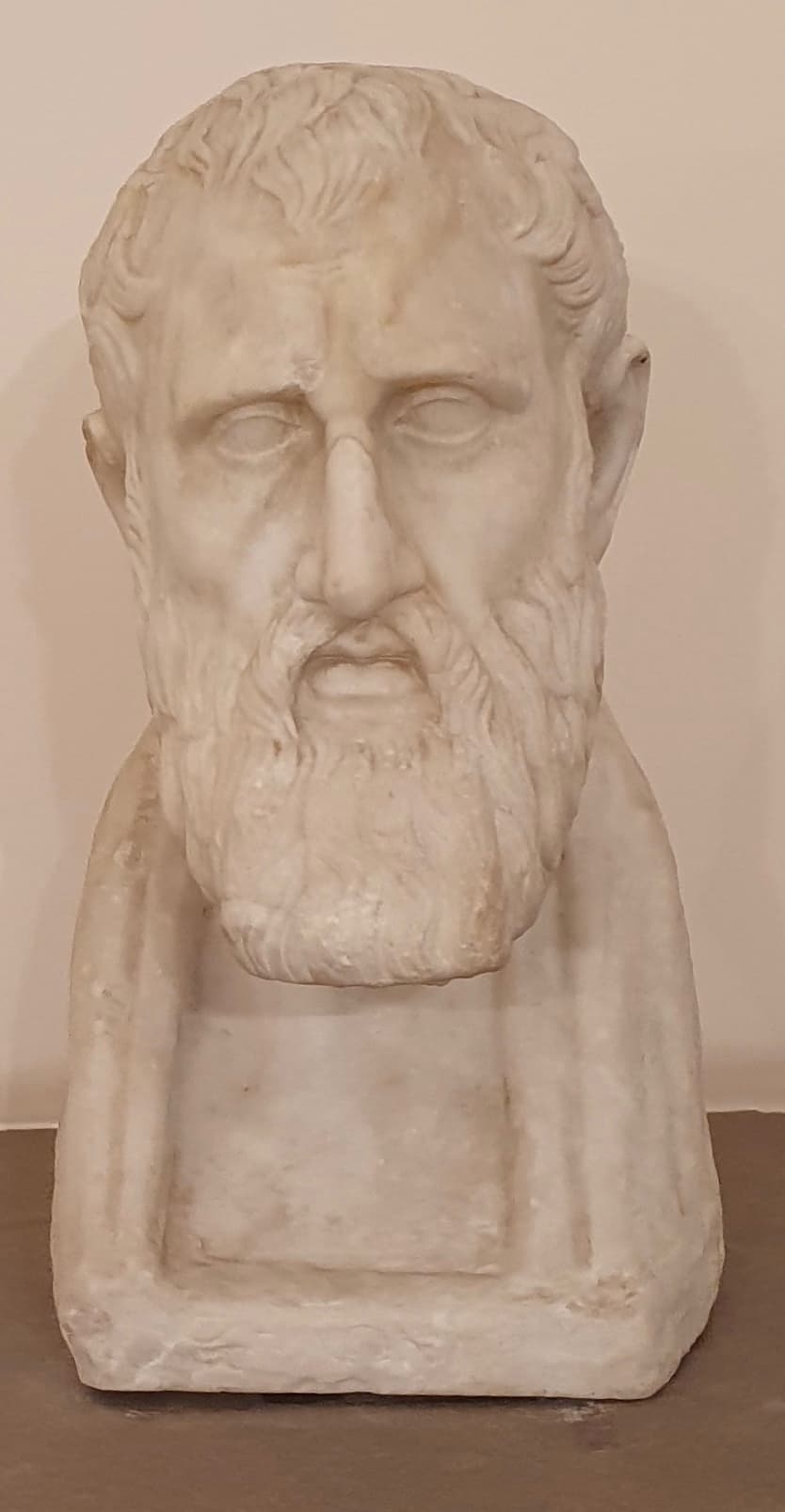
Portrait: Bust of Zeno, Farnese collection, Naples. Photo: Yair Haklai, CC BY-SA 4.0, via Wikimedia Commons