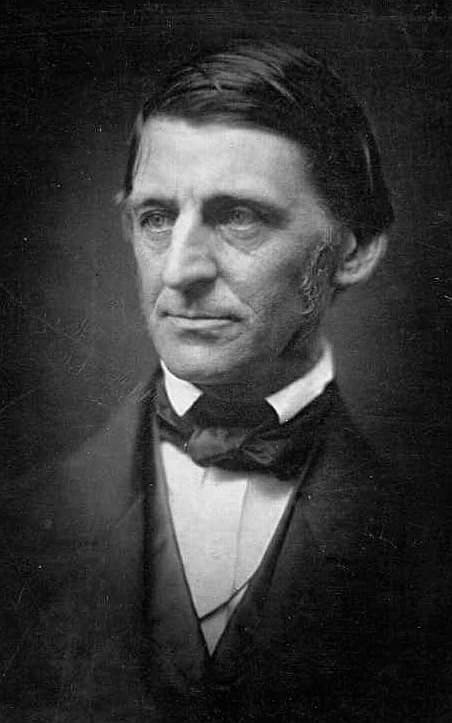
The Transcendentalists · 1803–1882
Ralph Waldo Emerson
The preacher who left the pulpit to trust the inner light
“Trust thyself: every heart vibrates to that iron string.”
His life
Emerson was a seventh-generation New England minister who found, a few years into the work, that he could no longer administer a ritual he did not feel. He resigned his Boston pulpit at twenty-nine, sailed to Europe grieving his first wife, and came home resolved to speak only what he had verified in his own experience. In 1836 he published a small anonymous book called Nature; it became the founding document of Transcendentalism.
From his house in Concord he made his living on the lecture circuit — hundreds of towns, decades of winters — turning the lectures into the essays that made him the most famous thinker in America: Self-Reliance, Compensation, The Over-Soul, Experience. His study became the movement's meeting room; his generosity, its funding. He walked daily, kept a journal for sixty years, and mined it for every page he published.
What he preached, from the platform instead of the pulpit, was self-trust — not self-satisfaction, but the discipline of listening for the voice under the borrowed opinions, and acting on it. He buried a son, weathered mockery of his 'newness,' and kept lecturing into old age as his memory failed. Asked late in life what he had been doing all those years, he might have answered with his own line: the one thing in the world of value is the active soul.
What he taught
Self-reliance
The center of everything Emerson wrote: imitation is suicide, envy is ignorance, and the voice within — heard in solitude, tested in conduct — is the only guide a person can finally follow.
The Over-Soul
Beneath individual minds, Emerson taught, runs one common life, the way coves and creeks hold one sea. Moments of insight, conscience, and love are that larger life breaking through.
Nature as teacher
Woods and stars are not scenery but scripture — a daily, wordless instruction in proportion and calm, available to anyone who will go outside and actually look.
In the Library
Portrait: Photograph of Emerson, c. 1857. Public domain, via Wikimedia Commons