The Transcendentalists · 1810–1850
Margaret Fuller
The critic who argued the soul has no sex
“Let us be wise, and not impede the soul. Let her work as she will. Let us have one creative energy, one incessant revelation.”
Her life
Fuller was educated by her father like a prodigy of the previous century — Latin at six, reading Virgil while other children played — and grew into the best-read person in the Transcendentalist circle, by their own admission. She taught, translated Goethe, and led her famous 'Conversations' in Boston: paid seminars where women, barred from universities, thought out loud about everything the age reserved for men.
Emerson recruited her to edit The Dial, the movement's magazine, where her essay on the rights and nature of women grew into Woman in the Nineteenth Century — the first major American argument that the soul has no sex and that every barrier around a woman's growth wounds the whole of humanity. Horace Greeley then hired her as the New-York Tribune's first female editor and foreign correspondent.
In Europe she found her way to revolutionary Rome, ran a hospital through the French siege of 1849, and married an Italian marquis turned republican soldier. Sailing home in 1850 with her husband and infant son, she drowned in a shipwreck within sight of Fire Island, New York. She was forty. Thoreau walked the beach for days searching for her manuscript on the revolution; it was never found.
What she taught
Let the soul work
Fuller's first principle: growth is the law of the soul, and nothing — custom, precedent, another person's convenience — has the right to impede it, in women or in anyone.
The soul poised on itself
Like the Stoics she read closely, Fuller held that relations stay precious only when a person stands on their own center first — union is best between whole beings, not halves.
Thinking as conversation
Her genius was dialogic: truth emerges between people who examine their lives out loud. Her Conversations made a university out of a parlor.
In the Library
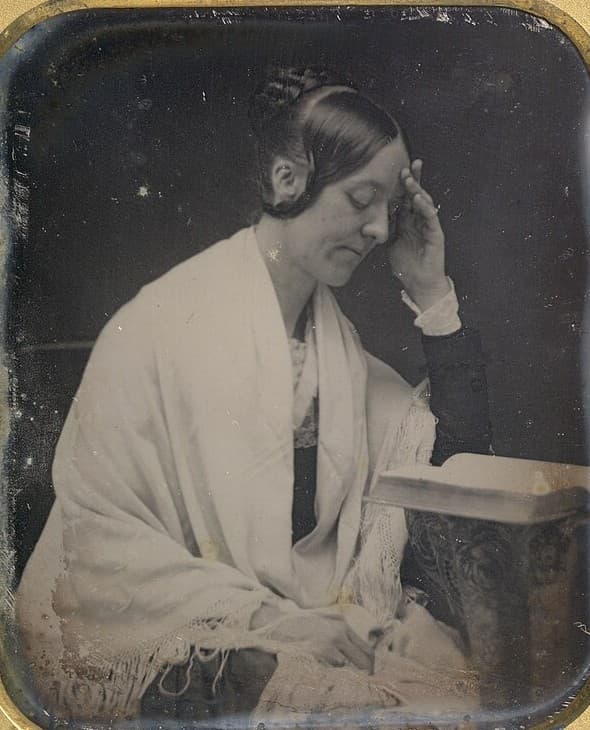
Portrait: Daguerreotype by John Plumbe, 1846, National Portrait Gallery. Public domain, via Wikimedia Commons